7/25/2009

Introducing the Green Heron

green heron rising
A small, stocky wading bird, the Green Heron is common in wet spots across much of North America. It can be difficult to see as it stands motionless waiting for small fish to approach within striking range, but it frequently announces its presence by its loud squawking. These excellent photos were taken by my husband. You'll see a variety of poses to help you ID a Green Heron of your own!

green heron crouch
This is the typical view of a Green Heron, prompting many to wonder if it is a heron at all.

greenheronfaceon
It's rare (and rather comical!)to see a face first view like this!

green heron upright
Now it is clear why this bird is in the Heron family. He has an elongated neck after all!

green heron profile
The Green Heron is one of the few tool-using birds. It commonly drops bait onto the surface of the water and grabs the small fish that are attracted. It uses a variety of baits and lures, including crusts of bread, insects, earthworms, twigs, or feathers.

green heron stare
Check out that baleful stare!

7/20/2009

Osprey: Eagle of the Sea


Osprey: The only raptor that hovers overs water and plunges feet first for fish. Blackish above and white below, Ospreys have a white head with a broad black mask over their eyes.


There is only one Osprey: they are the sole member of the family Pandionidae. Sometimes called Sea Eagles or Fish Eagles, Ospreys feed exclusively on fish. They are fairly common in coastal areas, but can also be found near any lake or river large enough to support a healthy fish population.


A short tail and long, narrow wings with long, finger-like feathers help identify an Osprey in flight.


Ospreys often build nests on man-made structures such as telephone poles or on nesting platforms built specifically for Osprey. Ospreys had almost disappeared by the early 1970s due to pesticides (like DDT) that caused severe eggshell thinning The ban on DDT and providing nesting platforms combined to restore the Osprey population fairly quickly. (For impressive pictures of an Osprey carrying a fish to it's nest and actually feeding it's young, check out this Osprey post on BirdingGirl!)


This is what I consider the typical view of an Osprey in flight. The wings are crooked more sharply than a gull's wings, and the raptor shaped head is easy to distinguish from a gull's head.


The Osprey's mask is often the only way to distinguish it from another black and white raptor: the American Eagle.


This is an unusual view of an Osprey's because of the bright sunlight shining through it's wings and tail.

7/15/2009

Seagull Snatches Shark!

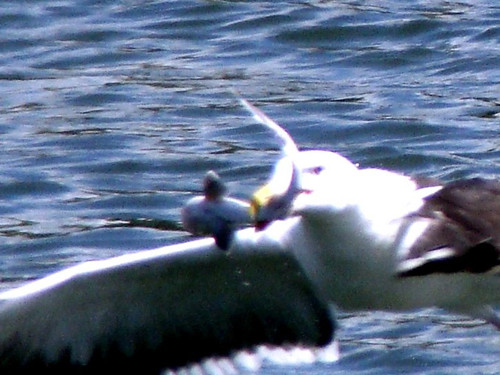
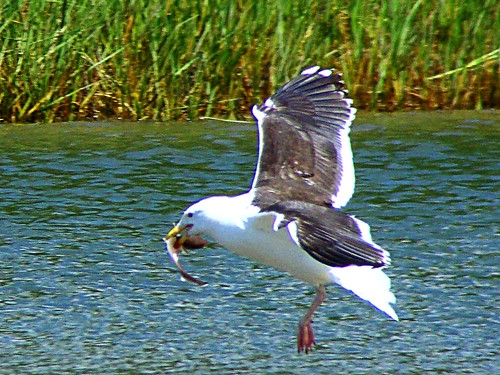
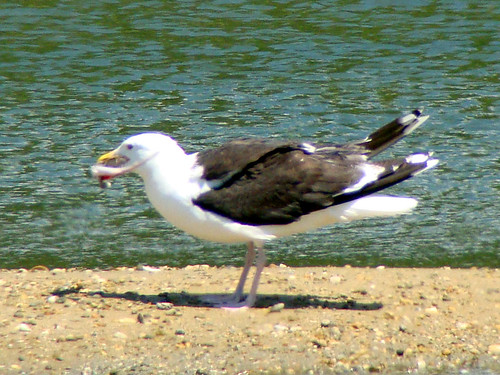
I was thrilled to get an action shot of a gull fishing(not a seagull- there's no such bird). I was especially happy to have captured a Great Black-Backed Gull (by far the biggest gulls in the world) in such a dramatic moment. I didn't even notice he had snatched up a SHARK until later!

There is no mistake. It is definitely a shark. I didn't know there were sharks around here, but we do. Evidently they are Sand Sharks, which are not dangerous or very large.

Great Black-Backed Gulls are HUGE. They are 2 1/2 feet tall and have a 5 1/2 foot wingspan! According to Whatbird, they are "Pugnacious, predatory and opportunistic. Omnivorous. May take prey as large as other gulls, cormorants, and rabbits," and "can swallow a puffin or a small wild duck whole."

I never cared about gulls before, but a gull that can catch and swallow a shark caught my attention! How could you not be fascinated with a bird that can swallow a whole duck? These guys are near the top of the food chain - the only bird that will prey on a Great Black Backed Gull is an eagle!

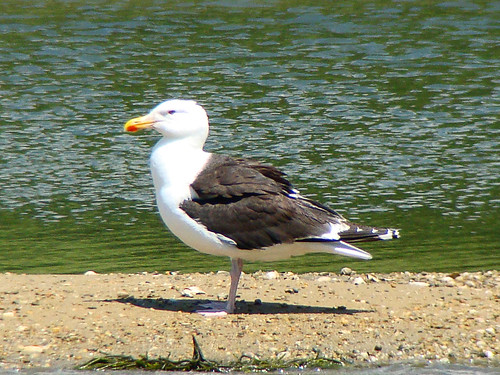
They are fascinating birds, too. They don't reach full maturity for the first four years of their lives. Like the American Eagle, the juvenile birds look very different from the adults. The distinctive black and white plumage is only seen on mature birds. Younger birds are speckled and have a dark bill. Adult Great Black-Backed Gulls have yellow bill with a red spot on the lower mandible. (The more common and familiar Herring Gulls also have a red spot on the lower bill, but Herring Gulls are smaller and have grey wings with black tips.)

Even in flight, the adult Great Black-Backed Gull is easily distinguished from other gulls in this area. The contrasting black and bright white colors are impressive and attractive. And they eat sharks! How cool is that!