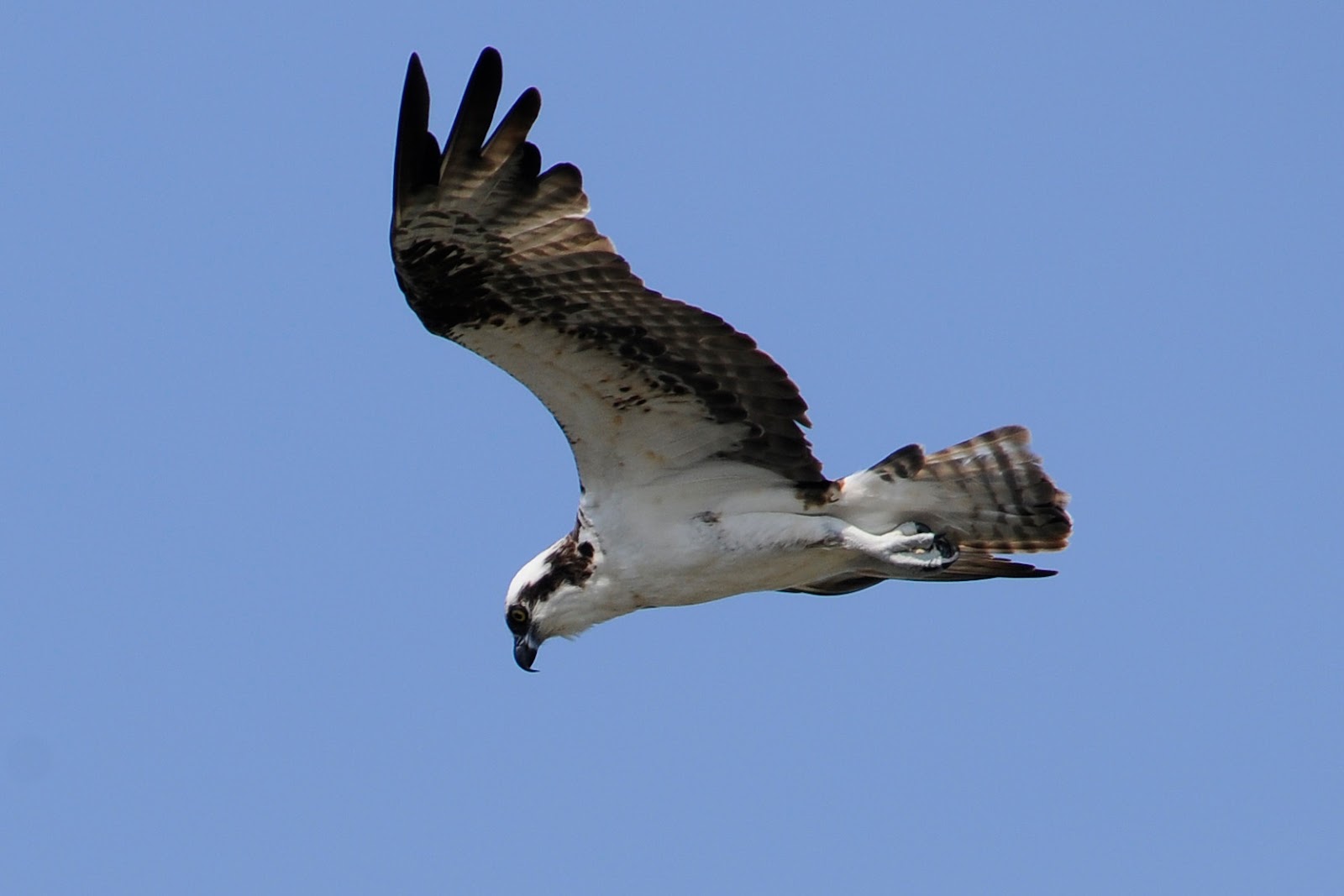
I almost fainted when I saw this Osprey fly over our heads yesterday. We were at a pond in Sherborn, Massachusetts in the middle of November. There shouldn't be any Osprey here! Thank goodness my good friend Pam was there with her camera ready! Pam - who has never before photographed a bird in flight - was able to get some outstanding photos to prove we saw what we saw!
I was jumping up and down with excitement, but neither Pam nor Carolyn are birders. They never heard of an Osprey, so it wasn't that much of a thrill for them to see one fly over a pond in Sherborn in November. As for me, I still can't believe that I saw him - and I still can't believe that these gorgeous shots were taken by someone who has never photographed a bird before.
From very far away I thought it was a GBH; as he came closer I decided it had to be a Great Black Backed Gull because it couldn't be anything else . . . I didn't recognize my summertime Cape Cod friend until he was practically overhead!
If Pam hadn't taken these amazing shots, I probably wouldn't have felt confident enough to report this sighting on eBird. I get very intimidated by the warning messages and the comments required when reporting a rare bird. With such indisputable proof in hand, however, it felt great to confirm and submit seeing an Osprey in Sherborn in November. Rare Bird Alert - with pictures posted on The Nature of Framingham blog!
Showing posts with label Osprey. Show all posts
11/12/2012
9/24/2011
Ospreys in Detail
I never believed that I could have too many Osprey photos - but I do!
This must have been a banner year for Osprey. I have dozens of shots of an Osprey right overhead, and Tom captured twice as many as I did!
This one is starting the typical 'Osprey Dance' that signifies that the hunt is on.
When it looks like they are dancing on air, they are actually searching for prey and getting ready to dive in and snatch it up..
Sometimes they dance for so long I give up on ever seeing a dive, which is what happened here!
9/12/2010
Ospreys and Herons in Trees
A family of three Osprey could be seen in the trees behind the railroad tracks almost every evening. One afternoon, I was able to get extremely close to one perching Osprey.
What a beauty he is! Check out the size of his talons, too.
In a fir tree a bit above the Ospreys you could usually count on a Great Blue Heron by afternoon. This bird seemed to rest every afternoon and hunt at dusk, which was a popular strategy in that cove.
There a few mixed heron rookeries close by this location, but this bird was always seen alone.
Maybe his offspring had already 'flown the nest', and he was enjoying the solitude and freedom.
7/31/2010
Face to face with an Osprey!
A quick trip down the Cape yielded some great birding. One of the highlights of the day was my husband getting these amazing closeup shots of an Osprey as circled overhead. In this picture, the Osprey is looking at the photographer as if he is potential prey.
A man-made Osprey nest at this location was occupied, but it was impossible to tell from our location whether the two black and white birds on the nest were young Ospreys. If so, their parents would be hard pressed to provide enough food for two full grown but still dependant offspring.
There are usually osprey to be seen at this marshy location, but rarely do they descend this low with humans about.
A magnificent predator, the osprey is also has a magnificent and intimidating appearance. In my opinion, they are as impressive as our other large black and white predator species, the American Eagle!
5/25/2010
Newborn Goslings and Nesting Osprey
A beautiful Canada Goose gosling. Seen at Daniel Webster Audubon Sanctuary in Marshfield, MA during Birdathon 2010 (5/15/2010).
A VERY close shot of mother goose.
We saw this Osprey at Daniel Webster, as well. But earlier in the day we had seen an occupied Osprey nest at Plymouth Beach!
Tom took dozens of photos, but it is very hard to see the Osprey in the nest in any one. This is probably the best, but view the picture LARGE or ORIGINAL on Flickr to get a good view.
The little guy on the right was flapping his arm as if he wanted to fly away!
We saw this Osprey at Daniel Webster, as well. But earlier in the day we had seen an occupied Osprey nest at Plymouth Beach!
Tom took dozens of photos, but it is very hard to see the Osprey in the nest in any one. This is probably the best, but view the picture LARGE or ORIGINAL on Flickr to get a good view.
7/20/2009
Osprey: Eagle of the Sea
Osprey: The only raptor that hovers overs water and plunges feet first for fish. Blackish above and white below, Ospreys have a white head with a broad black mask over their eyes.
There is only one Osprey: they are the sole member of the family Pandionidae. Sometimes called Sea Eagles or Fish Eagles, Ospreys feed exclusively on fish. They are fairly common in coastal areas, but can also be found near any lake or river large enough to support a healthy fish population.
A short tail and long, narrow wings with long, finger-like feathers help identify an Osprey in flight.
Ospreys often build nests on man-made structures such as telephone poles or on nesting platforms built specifically for Osprey. Ospreys had almost disappeared by the early 1970s due to pesticides (like DDT) that caused severe eggshell thinning The ban on DDT and providing nesting platforms combined to restore the Osprey population fairly quickly. (For impressive pictures of an Osprey carrying a fish to it's nest and actually feeding it's young, check out this Osprey post on BirdingGirl!)
This is what I consider the typical view of an Osprey in flight. The wings are crooked more sharply than a gull's wings, and the raptor shaped head is easy to distinguish from a gull's head.
The Osprey's mask is often the only way to distinguish it from another black and white raptor: the American Eagle.
This is an unusual view of an Osprey's because of the bright sunlight shining through it's wings and tail.
Subscribe to:
Posts (Atom)