6/05/2010

It CAN'T be a Lesser Black-backed Gull - or can it?

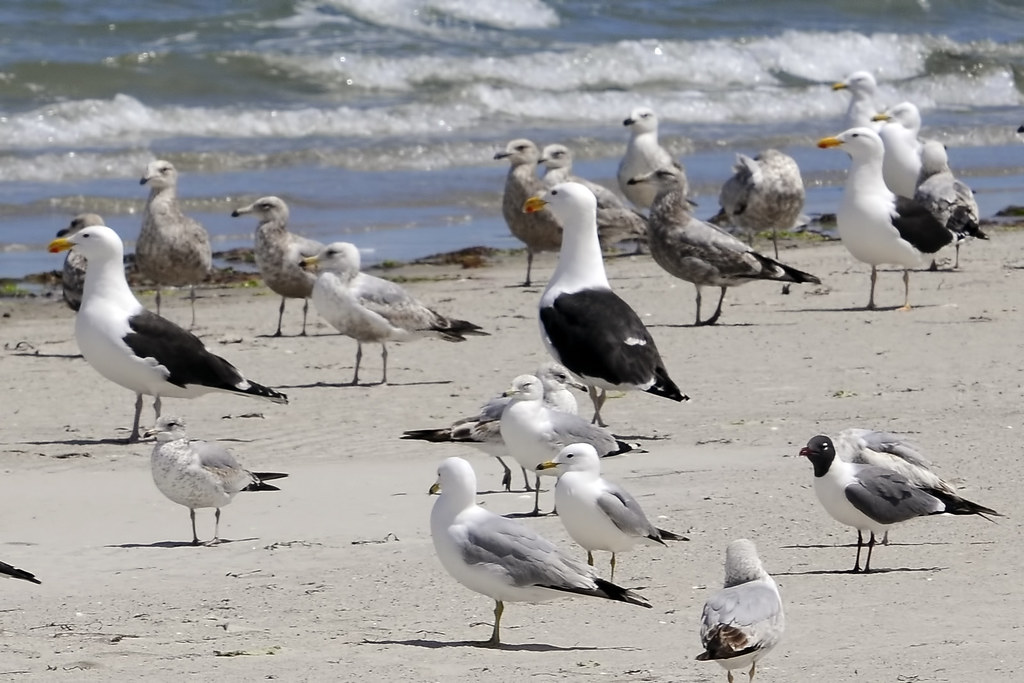
You probably don't remember the big excitement last summer when I had a confirmed sighting of a Lesser Black-backed Gull.  It was a thrilling experience because these are rare visitors from Europe that are occasionally blown clear across the Atlantic to end up in Massachusetts.  They closely resemble our local Great Black-backed Gull (a species I am particularly fond of ever since I saw one catch and eat a shark!) The Lesser Black-backed Gull is smaller and has yellow legs and feet; a very noticeable difference from the GBBG's pink legs and feet.  But what have we here?  Is it another Lesser Black-backed Gull?

It can't be a Lesser Black-backed Gull.  It is impossible, despite the fact that the other two big black and white gulls have pinkish feet and legs and the one on the right does not.  I couldn't find a single sighting of a Lesser Black-backed Gull in Plymouth (or maybe anywhere in Massachusetts) in the month of May!
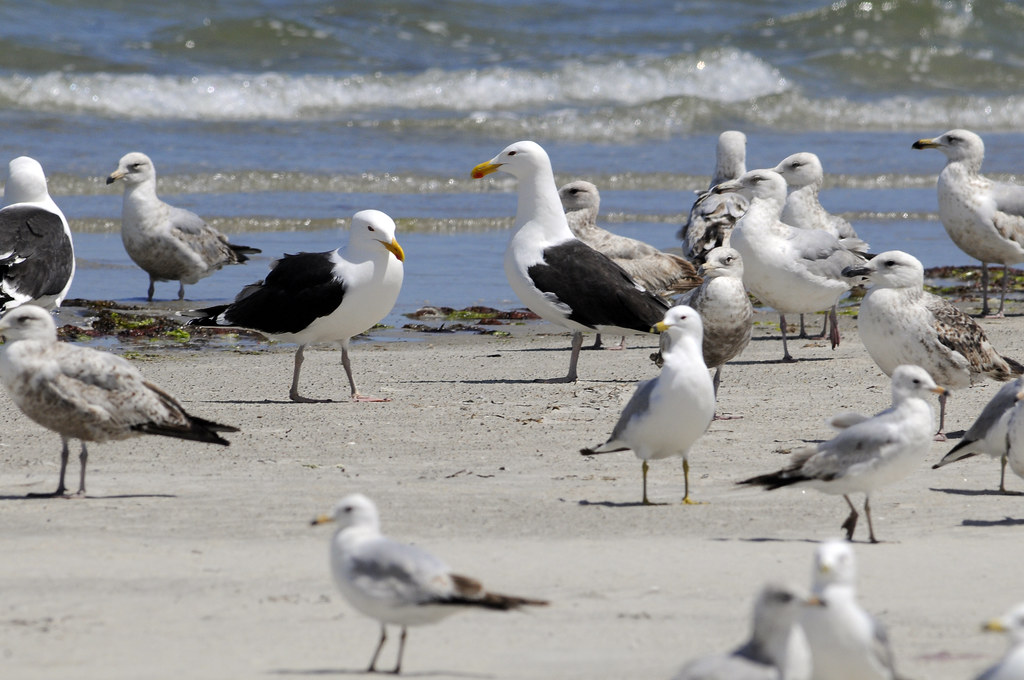
Great Black-backed Gulls have pinkish legs and feet like the ones above. The one with yellowish looking legs might have gotten his pink legs all sandy.  It is one possible explanation. 
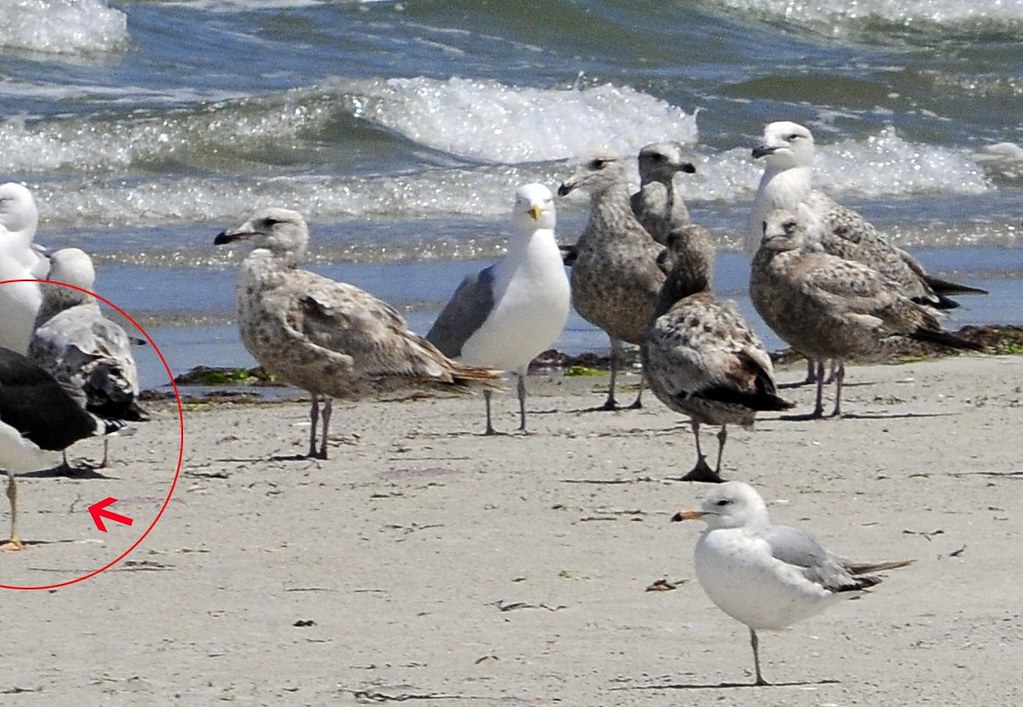
But check this out!  Black back.  Very yellow legs!  Maybe it really is a Lesser Black-backed Gull!  It must be!  Unless, of course, it is a hybrid of some sort.  But that would be REALLY weird!

UPDATE:  It is NOT a Lesser Black-backed Gull, unfortunately.  Maybe next time!!

6/04/2010

From Largest Tern to Least Tern!

Last week I posted images of the largest tern in the world, the Caspian Tern.  The same day we saw that massive bird, my son captured some great images of the smallest tern in America; the Least Tern.

As you can see, the Least Tern is quite distinctive even apart from his diminutive size - at this time of year, anyway.  Almost all terns have white or whitish foreheads at some point in their development, but in mid May you won't see such a perfect blazing white triangle on any other species. 

Another identification clue is the Least Tern's yellow (not orange) bill with a black spot at the tip.  The least Tern has yellow legs, as well.

The Least Tern does not nest in colonies with Common Terns, Roseate Terns, and Arctic Terns, which is why you won't see any group photos from us with those species together with Least Terns.  The Least Tern is much more apt to nest in marshes and lagoons and at the mouths of rivers, which is close to where we saw the bird above as well as some Least Terns in flight.


5/29/2010

Caspian Terns with Gulls and Common Terns

The massive size of these Caspian Terns can only be appreciated when you see them in comparison with the "normal sized" terns in our area (Common Terns, Roseate Terns, Forster's Terns, Arctic Terns, and even smaller Least Terns and Black Terns). It is also much easier to judge relative size when the birds are standing on the ground rather than flying.

Caspian Terns Common Terns and Various Gulls
 I had a very hard time finding photos that included both large and small terns on the web (although there must be thousands of them), and these are even better because of all the gulls in the group.  Check out the Caspian Tern on the far left that is looking straight up in the air!

Caspian Tern vs Common Tern
This is a closeup of the previous photo.  To me, the Caspian Terns look 4 times the size of Common Terns, which is about right.  The Caspian Tern's wingspan of 4.5 feet is almost twice the Common Tern's 2.5 foot wingspan, but the Caspian Tern weighs about 5 times what a Common Tern weighs.  Overall, the Caspian Tern is about 4X larger than the terns we are accustomed to seeing here in Massachusetts.

Gulls and Terns
Caspian Terns are larger than Laughing Gulls and larger than Ring-billed Gulls.  They are supersized terns, and I think they're super cool birds!